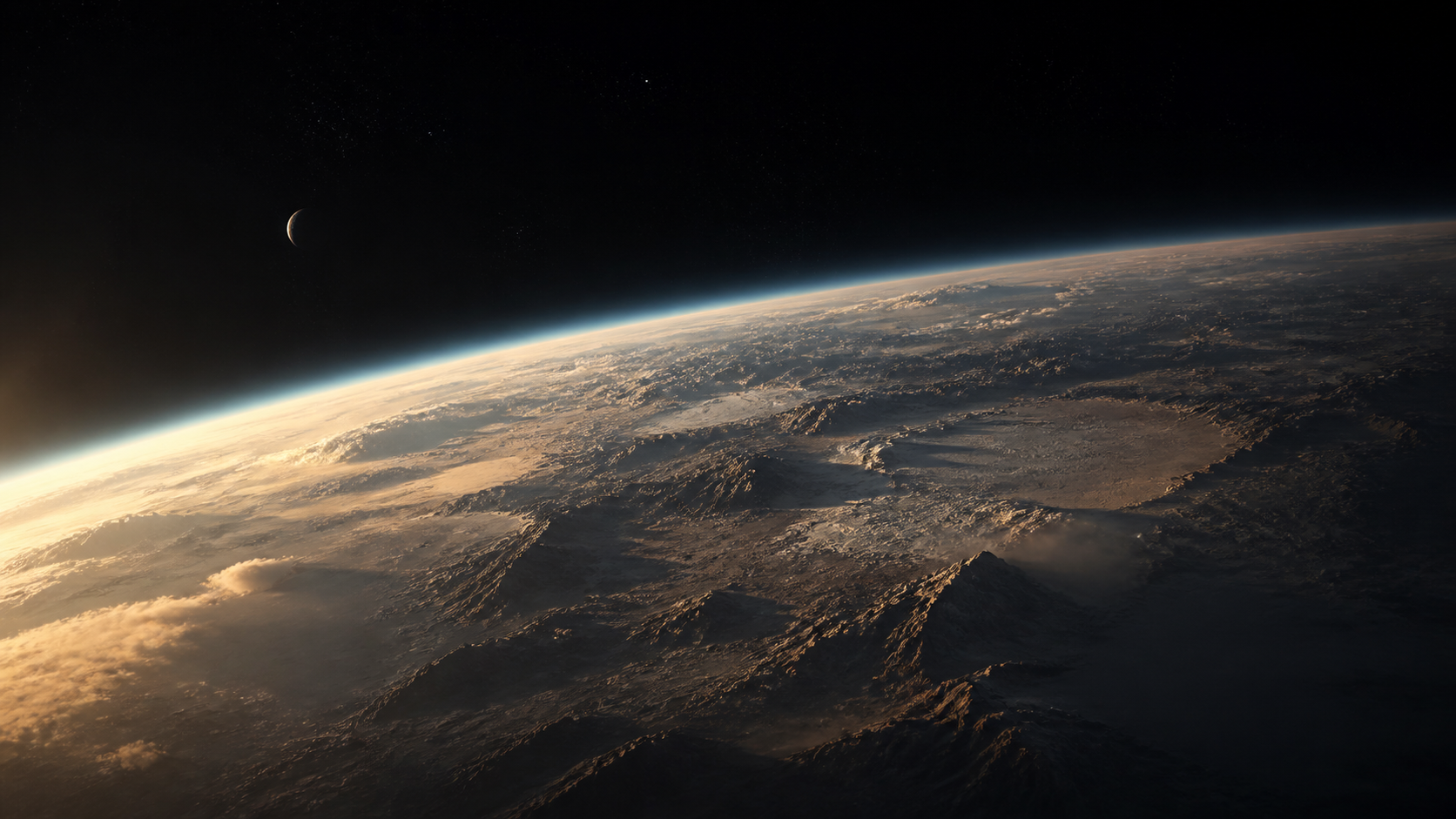
Three modules in one tool: slider-driven planet generation with GPU compute erosion, node-based starmap compositing with HDR pipeline, and biome-aware cloud systems. Produces PBR textures for sci-fi game worlds in seconds.
STARS BEYOND has procedurally generated planets across multiple biomes. Painting each texture by hand doesn't scale, so this tool was built alongside the game to rapidly produce unique planet textures. Now being developed into a standalone application.
The four worlds of the Eridan System in STARS BEYOND, each generated from tuned presets. Hybrid multifractal terrain, GPU erosion, PBR output and atmosphere rendering, all from sliders.
Node-based compositing for cinematic space backgrounds. An HDR pipeline with ACES tonemapping produces spatial envelope nebulae that look like real astrophotography, not procedural noise.
Full float64 processing with ACES tonemapping. Colors stay rich and natural through the entire compositing chain without clipping or banding.
Teal, Blue, Amber, Violet, Emerald. Each preset produces a distinct mood. Desaturated, subtle, Star Citizen style backgrounds.
DDS cubemap output in horizontal cross layout. Imports directly into Unreal Engine 5 as a TextureCube for skybox use.
Recursive noise for nebula shapes, domain warping for organic structures, star field layers with brightness in alpha. Full creative control.
Two generation modes for different tasks. Planets use a sequential slider pipeline for fast iteration. Starmaps use a node graph for creative compositing. Both produce production ready output.
PLANET (SLIDER-DRIVEN)
STARMAP (NODE-BASED)
Perlin noise, ridged multifractal, Voronoi tessellation, tectonic plates with continental drift simulation, crater fields and surface detail layers.
Domain warping for organic shapes, gaussian smoothing, terrace stepping, curves adjustment, normalize, clamp, invert. All with real time parameter sliders.
Pipe-model hydraulic erosion on OpenGL 4.3 compute shaders. Latitude correction for equirectangular projection. 4K erosion in 0.3 seconds on RTX 5080, plus thermal erosion with cliff preservation.
Height and slope based masks for selective blending. Altitude thresholds control where snow, sand or vegetation appears.
Gradient based colorization by altitude, slope aware shading, hillshade lighting, ocean coloring with depth falloff and polar ice caps.
Exports basecolor, heightmap, normal map (four scale UDN blending) and roughness. Packed texture export for engine ready channel packing.
Every planet generates a full equirectangular projection that maps directly onto a sphere in any game engine. The 2D preview shows the unwrapped texture with terrain, ocean, erosion and polar ice visible.
The built in 3D viewport renders the planet with vertex displacement, PBR material properties and atmospheric glow. OpenGL 4.3 with compute shaders for GPU erosion. Immediate visual feedback while adjusting sliders.
Heightmap data drives actual geometry displacement on the sphere, not just a flat texture. Mountains and valleys are visible in silhouette.
Four scale normal blending (macro, meso, fine, micro) using UDN technique with 2x shader amplification. Surface detail comes from lighting alone.
Fresnel based atmosphere glow with auto coloring derived from the planet's surface palette. Adjustable density and color override.
Orbit with left mouse, pan with middle mouse, zoom with scroll. Full interactive inspection of the generated planet from any angle.
DearPyGui for the full desktop application: node editor, properties panel, 3D viewport and toolbar. GPU accelerated immediate mode UI.
Custom spherical noise functions (fBm, ridged, Voronoi, domain warp) with Numba JIT compilation for near native performance on large textures.
OpenGL 4.3 with custom GLSL shaders for PBR rendering and compute shaders for erosion. Vertex displacement, atmosphere glow and thread-safe GPU context management.
Custom DAG execution engine with topological sort, dirty flag propagation and type safe pin connections. 34 node types across 7 categories.
Generators, combiners, filters, erosion, selectors, color and output nodes. Covers the full planet creation workflow.
Planet presets for every biome, 5 cinematic starmap themes, 16 cloud variants across 6 biome types. Covering the full Eridan System and beyond.
Basecolor, heightmap, normal map, roughness and packed exports. All generated from a single graph, ready for import into any game engine.
Macro, meso, fine and micro normal layers blended with UDN technique. Surface detail comes from lighting, not color noise.
4K hydraulic erosion in 0.3 seconds. OpenGL 4.3 compute shaders with pipe-model simulation, latitude correction, and thermal erosion. 500x faster than CPU.
Slider-driven planet generation, node-based starmap compositing, and biome-aware cloud systems. Each optimized for its task.
The Universe Generator is actively in development alongside STARS BEYOND. Most core systems are complete. Current focus is preset tuning and UE5 integration.
| Phase | Status | Scope |
|---|---|---|
| Node System | Complete | DAG engine, 34 nodes, graph execution, dirty caching |
| Slider Engine | Complete | Planet v2 pipeline, debounced auto-regeneration, preset loading |
| GPU Compute | Complete | OpenGL 4.3 compute shaders, hydraulic erosion, thread-safe context |
| PBR Export | Complete | Basecolor, height, normal, roughness, packed channel export |
| Cloud System | In Progress | 6 biome types, 16 presets, cyclone warp, GPU rendering |
| Save / Load | Complete | JSON graph serialization for starmaps, preset system for planets |
| Standalone Release | Planned | Packaged desktop app, documentation, community presets |